Showing posts with label love. Show all posts

Sunday, June 16, 2013

52 Poems to Adam: "Papa"

On this Father's Day I decided to write a poem in part for the father that Adam didn't have a chance in this life to be and in part for all the fathers in my life I know and love. As I wrote this poem, I was inspired by several father/son duos in my own family who encompass all the aspects of fatherhood. One of those duos is my brother Ben and his son Sean, another is my brother Joseph and his son Bryson. And my own father and any one of his sons (or daughters). Lastly, it's how I envision it would have been for Adam and Jeffrey, how it was for them the small amount of time they had together.

This is to all you fathers, for your love, dedication, and care:


Papa

"Dad & Little Buddy": Dad and Andrew

Young

Still a child
Staring up with wide eyes
Seeing his hero
Bigger than life
Stronger than everyone
Than the world

Learning to walk toward that booming

Beckoning voice
Strong hands picking him up
After a fall
After a failure

Imitating him
His hero
With his toy hammer
Eager to be big
Like him
And help

Perched on the knee of a giant

Hearing stories
About life
Lessons learned through experience
And heartache
And faith

Working alongside

A master workman
Learning about devotion
And persistence
And sweat
And pride

Attached to his best buddy

Who holds him so easily
Effortlessly
Tossing him up
Catching him
Always catching him

Loving him through life

That solid, constant presence
A rock in the wild waters of change
Always there
Appearing when needed
A father
A papa's love and care

Thursday, April 11, 2013

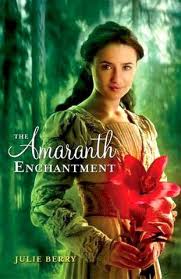
The Amaranth Enchantment

I really liked The Amaranth Enchantment, for the most part (and I'll get to that later). This story was an interesting mix of elements, with pieces of fantasy, fairy tale and the otherwordly. 

It starts out focusing on Lucinda doing a drudge's work and being degraded by the "master" of the establishment who also happens—surprise surprise—to be a relative. Actually, this Cinderella-esque twist to the story was one of the things I loved most about this book. I love retellings. Lucinda then goes on to meet a prince, a thief, and a witch, befriending all as she embarks upon the adventure of life (and I mean life, not lifetime, because isn't life an adventure?). She learns about her past and ultimately helps to foil the villain who had a hand in shaping that past.

It's all very interesting. But I love even more the themes of redemption and love and friendship, of not letting bad decisions define you, of rising above your past and making good choices. How many people in terrible situations blame others for their misfortunes? Often harm was done to them and it has affected them psychologically. But in the end, those victims need to make decisions to rise above it and take control of their lives. I know I'm being very vague here, but I know intimately what it's like to not let something beyond your control rule your life, to not let that thing become a crutch and an excuse for your own bad decisions. I like that Julie Berry addresses this in a very subtle, wholesome way.

However...

Yes, I did say "really liked" and "for the most part." What really stole the momentum of the story and let me down was the ending. The climax was great, and then the resolution happened in a blink. I wanted to know more about the romance between the prince and Lucinda (this is giving nothing away). It was suddenly just there at the end and I didn't feel as if I experienced it with the characters. The resolution was anti-climatic, if that makes any sense. It should have been drawn out a little, illustrated better, painted with the brush of Julie Berry's beautiful metaphors.

This all being said, I think I will read Julie Berry's Secondhand Charm to see how she treats her other endings. I will say that I'm aware of how a writer's work evolves over time, being a writer myself, and this is only her second ever written book. I've written several and I'm aware of my own immature writing. I think that her work will only get better.

Friday, March 22, 2013

Keturah and Lord Death

I've recently read Keturah and Lord Death and loved it. It comes as no surprise that this is another historical fiction. I have an addiction for them, especially when they are well-written and lyrical, weaving together elements of both history and magic.

To get started, this book takes place in some nebulous past, which could just as easily be a completely different world. It doesn't talk much about the time period, but Martine Leavitt—the oh so talented author—mentions 1) the plague and 2) serfdom. Both suggest that this story occurs during the Middle Ages.

The story starts out focusing on 16-year-old Keturah as she lies dying in the snow. Then we meet death—Lord Death—who is beautiful and stern and otherworldly. He arrives to take Keturah away on his black horse. Instead they strike a bargain, and Keturah must find her true love within a matter of days or go with Death.

Without giving anything away, it's amazing how Keturah changes over the course of a few days. She learns more about herself in those few days then she did all the years before. This book is written like a fairy tale, but it delves into deeper issues, ideas of love and death and courage. Keturah finds out what's important and what's worth fighting for. She also learns not to fear death, that it is a dear intimate and a friend and only a step in a much larger journey.

I adore Lord Death. His motivations are so elusive. Why does he strike a deal with Keturah? It's within his power to take her at the beginning, yet he breathes life into her and waits. And each day he holds out judgement and gives her time. But once in a while Leavitt allows you a glimpse of this being, a look into a lonely, wistful soul. It's fascinating.

I'm almost as enamored with Leavitt's writing as I am with the story itself. The writing is lyrical and haunting and beautiful. Although this book was published in 2006, it has the timbre of classical works, with melodious phrases and profound quotes that you just have to highlight (and I do). One such quote spoken by Lord Death: "Each man, when he dies, sees the landscape of his own soul" (715 of 740—sorry, I only have the digital version). This is a seriously fascinating theological idea. Here's another favorite quote: "In this suffering she found the best sort of perfection—the kind that never demands it of others" (730 of 740).

This is my very favorite quote because although nobody alive can know for sure what if feels like to die, I think this must be close:
"Tell me what it is like to die." 
"You experience something similar every day," he said softly. "It is as familiar to you as bread and butter."
"Yes," I said. "It is like every night when I fall asleep."
"No. It is like every morning when you wake up."
"It's like every morning when you wake up." Those words just give be goosebumps. It feels true.

This book has all the qualities I love in great literature: captivating, interesting, funny, well-written, beautiful, and profound. Read it. You'll love it.